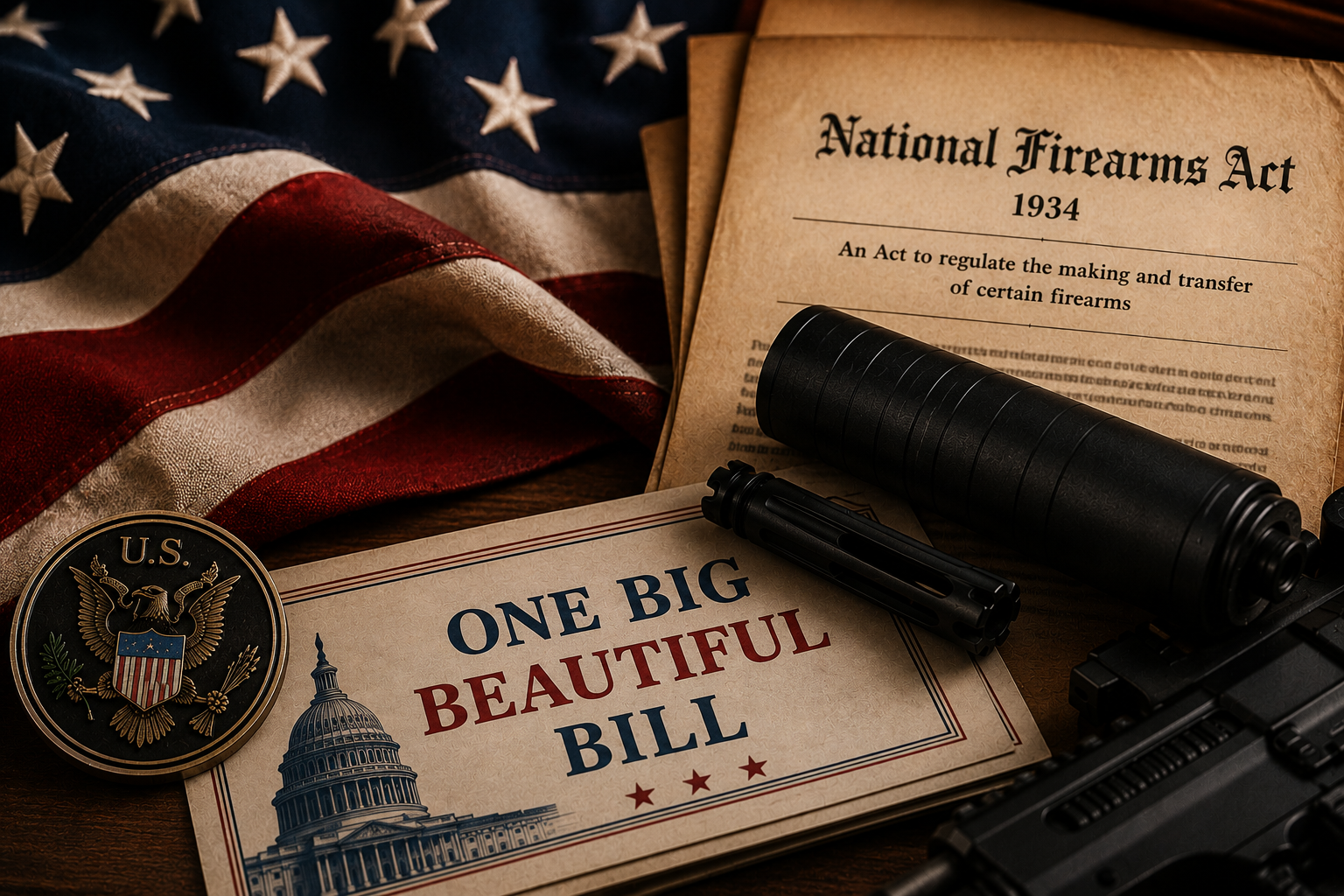
The National Firearms Act (also known as the NFA) has regulated certain categories of firearms and accessories since 1934. For most of that time, owning an NFA item meant paying a $200 tax stamp, submitting fingerprints and photographs, filing paperwork with the ATF, and waiting months, sometimes close to a year, for approval.
That changed on January 1, 2026. The $200 tax stamp fee was eliminated as part of the One Big Beautiful Bill Act (H.R. 1) signed into law in July 2025. The paperwork and approval process remain in place. The financial barrier does not.
What the National Firearms Act Is
The NFA was passed in 1934 as the federal government’s response to Prohibition-era gang violence. The Thompson submachine gun and sawed-off shotguns were the primary targets. Rather than outright banning these items, Congress imposed a $200 transfer tax, equivalent to roughly $4,500 in today’s dollars, to make them prohibitively expensive for most people to own.
The NFA has been amended several times since 1934, most significantly in 1986 when the Hughes Amendment banned civilian ownership of machine guns manufactured after May 19, 1986. That restriction remains in place today regardless of the 2026 tax changes.
What the NFA Covers
Six categories of items are regulated under the NFA:
Suppressors Also called silencers, suppressors reduce the sound of a firearm’s report by slowing and cooling the expanding gases that exit the muzzle when a round is fired. They do not make firearms silent. The “Hollywood silencer” is a fiction. A suppressed firearm is still loud. Suppressors are legal for civilian ownership in 42 states with ATF approval.
Short-Barreled Rifles (SBRs) A rifle with a barrel length under 16 inches or an overall length under 26 inches is classified as an SBR under federal law. This includes AR-15 platforms with shorter barrels and many pistol-caliber carbines. The ATF’s 2023 rule reclassifying pistols with stabilizing braces as SBRs was overturned, meaning those pistols no longer require NFA registration.
Short-Barreled Shotguns (SBSs) A shotgun with a barrel length under 18 inches or an overall length under 26 inches is classified as an SBS. Tactical shotguns with short barrels fall into this category.
Machine Guns Any firearm that fires more than one round per trigger pull is classified as a machine gun under federal law. Civilian ownership is restricted to machine guns manufactured and registered before May 19, 1986. These pre-1986 transferable machine guns are legal federally but are rare and expensive, typically $10,000 to $50,000 or more depending on the model, because no new ones can enter the civilian market. Several states ban them entirely.
Destructive Devices This category covers grenades, rocket launchers, explosive devices, and certain large-bore firearms with a bore diameter over half an inch. Civilian ownership is possible with ATF approval but rare and highly restricted.
Any Other Weapons (AOWs) AOWs are a catch-all category covering items that do not fit neatly elsewhere. This includes certain pistols with vertical foregrips, pen guns, cane guns, and similar concealable firearms. AOWs carried a $5 transfer tax rather than $200. That $5 fee has also been eliminated under the 2026 changes.
What Changed in 2026
The One Big Beautiful Bill Act, signed into law on July 4, 2025 by President Trump and effective January 1, 2026, eliminated the federal tax stamp fee for suppressors, SBRs, SBSs, and AOWs. The bill passed the Senate 51-50, with Vice President JD Vance casting the tie-breaking vote. The $200 fee that had been a fixture of the NFA process since 1934 is gone for those four categories.
What did not change:
- ATF Form 4 is still required for transfers from a dealer to an individual
- Fingerprints, photographs, and background checks are still required
- State and local laws still apply. Federal approval is not a state permit
- The registration requirement remains fully in place
- Machine gun and destructive device tax stamps were NOT eliminated. The $200 fee remains in place for those two categories
- Machine gun restrictions from the 1986 Hughes Amendment are unchanged
The financial barrier is gone. The regulatory process is not.
The practical effect has been significant. Without the $200 per-item cost, suppressor purchases have surged. ATF approval times have dropped dramatically in response to procedural improvements at the agency. As of May 4, 2026, approval times run approximately 4 days for individual filings and 18 days for trust filings, compared to waits of six months to a year that were common just two years ago.
How the Process Works
If you want to buy a suppressor, SBR, or other NFA item from a licensed dealer, here is how the process works:
Step 1: Find the item and a licensed dealer NFA items must be transferred through a licensed NFA dealer who holds a Federal Firearms License with a Special Occupational Taxpayer (SOT) designation. Not every gun store handles NFA transfers. Confirm before you go.
Step 2: Complete ATF Form 4 The Form 4 is the application for a tax-paid transfer. It requires your personal information, fingerprints, a passport-style photograph, and signature. As of 2026, no payment is required. The form can be filed electronically through the ATF’s eForms system, which is the fastest method.
Step 3: Wait for ATF approval Once submitted, the ATF runs a background check and reviews the application. With the current eForms system, individual filings are being approved in approximately four days. Trust filings are taking approximately 18 days. You cannot take possession of the item until the Form 4 is approved.
Step 4: Take possession Once approved, you receive your approved Form 4. You go to the dealer, complete a standard Form 4473 (the same background check form used for any firearm purchase), and take the item home.
Keep your paperwork Your approved Form 4 should travel with the NFA item. If you transport a suppressor or SBR, having a copy of the approval is practical. Law enforcement may ask for it.
Individual Filing vs. NFA Trust
You can register an NFA item as an individual or through an NFA gun trust. Here is the practical difference:
Individual filing: Faster approval currently. The item is registered to you personally. Only you can possess it. If you die, the item must go through the transfer process again for heirs.
NFA trust: Slightly slower approval currently. Multiple people named as trustees can legally possess the item. Easier for estate planning and for situations where a spouse or family member may need access to the item. Many NFA dealers and attorneys offer standardized trust documents for this purpose.
For most first-time buyers, an individual filing is simpler and currently faster. If estate planning or shared access matters to you, a trust is worth considering.
Which States Allow NFA Items
Federal approval does not override state law. Several states restrict or prohibit specific NFA categories regardless of what the ATF approves.
Suppressors: Legal with federal approval in 42 states. Prohibited in California, Delaware, Hawaii, Illinois, Massachusetts, New Jersey, New York, Rhode Island, and the District of Columbia.
SBRs: Legal with federal approval in most states. Prohibited or restricted in California, New Jersey, and a small number of others. Verify current state law before filing.
Machine guns: Legal federally for pre-1986 registered transferable guns. Banned in California, Hawaii, Illinois, Iowa (certain categories), Kansas (certain categories), Minnesota, New Jersey, New York, Rhode Island, and Washington.
For current state-by-state information, the American Suppressor Association maintains an updated map for suppressors specifically.
Common Misconceptions
“Suppressors are illegal.” They are legal in 42 states with ATF approval. They have never been illegal at the federal level. They have been regulated and taxed since 1934.
“Suppressors make guns silent.” They do not. A suppressed 9mm pistol still produces approximately 130 decibels, comparable to a jackhammer. Suppressors primarily protect hearing and reduce noise complaints at ranges. They are not the near-silent devices depicted in films.
“The NFA was repealed in 2026.” It was not. The tax stamp fee was eliminated. The NFA remains in full effect. Registration, background checks, and ATF approval are still required for every NFA item transfer.
“You need special permission to transport an NFA item across state lines.” For most NFA items, you do not need prior ATF approval to transport them across state lines for lawful purposes. However, you must comply with the laws of every state you enter. Transporting a suppressor through a state where suppressors are illegal is a federal crime even if you are just passing through.
The Takeaway for 2026
With the $200 tax stamp eliminated and approval times down to days rather than months, 2026 is the most accessible period for NFA ownership in the history of the law. If you have been curious about a suppressor for hunting, hearing protection, or range use, or an SBR for a more maneuverable home defense platform, the process is now faster and cheaper than it has ever been. The paperwork is still there. The financial penalty is not.
Check your state’s current laws before filing. Federal approval does not override state restrictions, and NFA regulations continue to evolve through ongoing legal challenges. The ATF’s official NFA page is the authoritative source for current federal requirements.
This article is for informational purposes only and does not constitute legal advice. NFA regulations and state laws change. Verify current requirements at atf.gov and consult a qualified attorney before making decisions based on this information.