Not to frighten you, but hearing loss from shooting can be permanent and cumulative. Every shot without adequate protection does damage that does not heal. A single unsuppressed gunshot can exceed 140 decibels, well above the 85 dB threshold where sustained exposure begins causing damage, and in the range where a single exposure can cause permanent harm.
The good news is that good hearing protection (commonly referred to as “EarPro”) is inexpensive, widely available, and not complicated to choose.
Understanding NRR
Every piece of hearing protection carries an NRR rating. NRR stands for Noise Reduction Rating. It is a single number measured in decibels that represents how much sound the protection reduces under laboratory conditions.
An NRR of 22 means the protection reduces noise by approximately 22 dB in a controlled test. In real-world use, the actual attenuation is typically lower than the rated NRR because of fit, seal quality, and user technique. A common rule of thumb is to divide the NRR by two for a conservative real-world estimate.
For shooting, aim for an NRR of 22 or higher. Most quality hearing protection for range use falls in the 22 to 33 range.
One important note on doubling up: when you wear foam plugs underneath earmuffs, the combined protection is not simply the sum of both NRR ratings. Per OSHA guidance, the effective combined NRR is approximately the higher of the two ratings plus 5 dB. So foam plugs rated NRR 33 worn under earmuffs rated NRR 22 gives you roughly 38 dB of effective protection, not 55.
Passive vs. Electronic
The most important decision in hearing protection for shooters is whether to go passive or electronic.
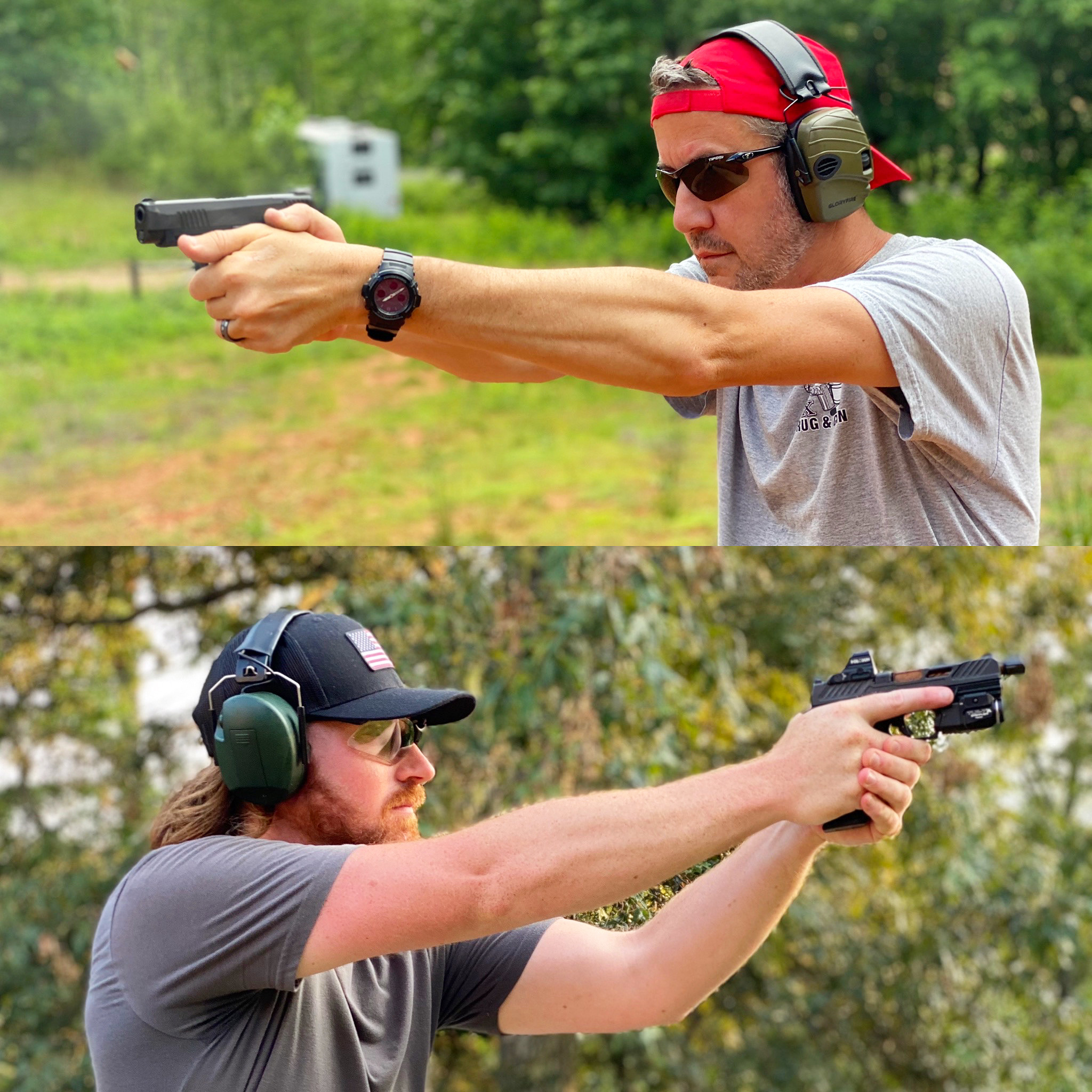
Passive hearing protection simply blocks sound. Foam earplugs and standard earmuffs with no electronics fall into this category. They are inexpensive, reliable, and effective. The tradeoff is that they block everything: range commands, conversation, and the sounds of the environment around you. For hunters, this creates a real problem because you cannot hear an animal approaching. For range shooters, it can make communication with a range officer or a shooting partner difficult.
Electronic hearing protection uses microphones and speakers to pass ambient sound through at a safe amplified level, then compresses or cuts sound instantly when gunfire exceeds a set threshold, typically around 82 to 85 dB. The result is that you can hear conversation and environmental sounds normally, and the electronics protect your hearing the moment a shot is fired.
For most shooters, electronic hearing protection is worth the additional cost. The ability to hear range commands, communicate naturally with other shooters, and maintain situational awareness while hunting makes electronic protection significantly more practical than passive for regular use.
Over-Ear Earmuffs vs. In-Ear Options
Over-ear earmuffs are the most common format. They are easy to put on and take off, work reliably, and are available at every price point. The main limitation for rifle shooters is cup depth. A thick earmuff cup can interfere with cheek weld on a rifle stock, pushing the shooter’s head slightly away from the stock and affecting accuracy. Slim-profile electronic earmuffs address this specifically.
In-ear electronic options have grown significantly in recent years. They eliminate the cheek weld problem entirely, often carry a higher NRR than comparable earmuffs, and are more compact for hunting and field use. The tradeoffs are battery life: rechargeable in-ear options typically run 6 to 25 hours versus 40 to 600 hours for AAA-powered earmuffs, and the need to seat them correctly in the ear canal every time for full effectiveness.
EarPro Worth Knowing
Howard Leight Impact Sport The Howard Leight Impact Sport is the most widely recommended entry-level electronic earmuff in the shooting community. NRR 22, sound amplification up to 82 dB, slim profile for rifle use, runs on AAA batteries with approximately 350 hours of battery life. At approximately $55 on Amazon it has earned its reputation as the best value electronic earmuff available. The Impact Pro version carries an NRR of 30 and is better suited for indoor ranges and high-volume shooting.
Howard Leight Impact Sport on Amazon
Howard Leight Impact Pro on Amazon
Walker’s Razor Slim (Tuebor USA’s personal favorite) The Walker’s Razor Slim is the go-to recommendation for rifle shooters specifically. The ultra-slim cup profile minimizes interference with cheek weld better than most competitors. NRR 23, sound amplification, available with Bluetooth for taking calls or running a shot timer app. Approximately $45 to $75 depending on the version.
3M Peltor Sport Tactical 500 The Peltor Sport Tactical 500 is the recommended step-up option for indoor range use. NRR 25 to 26 depending on the variant, Bluetooth connectivity, and better sound compression circuitry than entry-level options. At approximately $100 it is the right choice for shooters who spend significant time at indoor ranges where sound levels are more intense and sustained.
3M Peltor Sport Tactical 500 on Amazon
Howard Leight Disposable Foam Earplugs For passive protection, foam earplugs are the most effective per dollar spent. Howard Leight disposable earplugs carry an NRR of 33, the highest available in a standard earplug format, and cost a few dollars per pair in bulk. They are the standard recommendation for doubling up under earmuffs at indoor ranges, and a practical backup option to keep in any range bag.
Howard Leight Disposable Foam Earplugs on Amazon
When to Double Up
Doubling up, wearing foam plugs underneath earmuffs, is the recommended approach for indoor ranges, magnum calibers, muzzle-brake-equipped rifles, and any shooting environment where peak sound levels are consistently high.
A single layer of hearing protection handles most outdoor range and hunting situations adequately. When you are shooting a .308 with a brake inside a covered range, a single layer may not be enough. The combination of foam plugs at NRR 33 underneath earmuffs gives you effective protection in the 35 to 38 dB range, which handles any caliber configuration.
The practical setup many experienced shooters use: electronic earmuffs as the primary layer for communication and situational awareness, foam plugs added underneath when conditions warrant.
Can You Hear Me Now?
You can’t go wrong with any of the EarPro listed. Teyh handles range shooting and hunting, and their community track is sterling.
Keep a box of foam earplugs in your range bag regardless of what else you use. They weigh nothing, cost almost nothing, and are the right answer when conditions call for doubling up or when a guest at the range needs protection.
Your hearing is the one piece of equipment you cannot replace.
This article contains affiliate links. Tuebor USA may earn a commission if you purchase through these links at no additional cost to you. Links are updated periodically but pricing and availability may have changed since publication. Always verify current pricing at the retailer before purchasing.